Featured publication
A Homegrown Solution: RISE photobook
Women building livelihoods in Ethiopia’s Somali Region. Revised 23-page web edition.

Research, practical tools and publications from CAAP’s work.
Women building livelihoods in Ethiopia’s Somali Region. Revised 23-page web edition.
Published evidence on vaccination, awareness and access, with study context.
Qualitative insights on violence, gender norms and community priorities.
How women and men share decisions, work and resources in two Gode kebeles.
Somali communication materials co-developed with Girl Effect.
CAAP’s annual account of programmes and organisational progress.
English and Somali poster collections for community engagement.
Cards supporting informed discussion on FGM myths and facts.
Practical videos and guidance manuals for resilient agriculture.
A programme concept connecting remittances and resilience.
A case study of the Ebyan Initiative in Gode.
CAAP’s goal, four programme pillars and pathways from relief to resilience, women’s empowerment and graduation.
Programmes and organisational progress during 2024.
Programmes and organisational progress during 2023.
Who CAAP is: mission, identity, footprint and strategic approach.
What CAAP can deliver: technical expertise, systems, partnerships and operational capacity.
Try a different search or clear the filters.
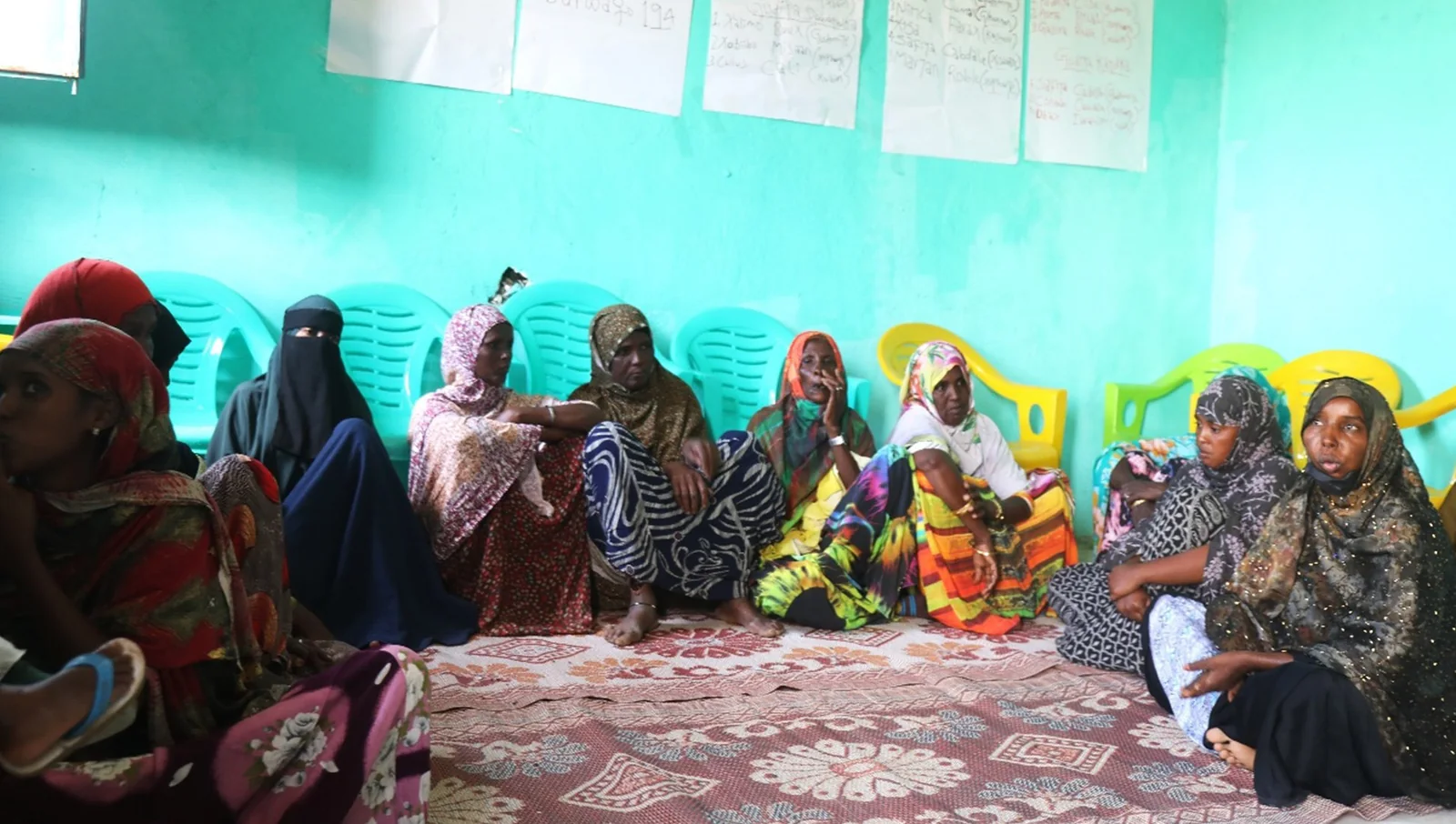
The revised 2025 RISE photobook is presented as 23 online pages, with paired photographs, captions and readable text. Explore women’s experiences in gardening, poultry, enterprise and cooperative saving. RISE is implemented by CAAP with UN Women’s support. The edition preserves the source publication’s dated accounts and figures; personal stories are distinct from programme-wide results.
Revised web edition · 23 pages · Readable text
CAAP implemented local HPV vaccination demand-generation activities in Jigjiga with Girl Effect and supported the evaluation with Girl Effect and JSI.
In the pooled endline comparison, intervention districts reported 89% of girls aware of the HPV vaccine, 88% of caregivers aware, 82% reporting easy vaccine access and 81% of eligible girls vaccinated—20, 25, 13 and 19 percentage points higher than comparison districts, respectively. These are differences between study groups, not changes from a baseline or CAAP-only impact estimates.
January 2025 · Study-wide results: Jigjiga and Derashe (intervention districts), compared with Gode and Kolango Zuria.
Differences are calculated from the rounded percentages reported in the publication.
Study design and scope: The cross-sectional, mixed-methods evaluation surveyed 1,134 girls and 950 caregivers after Ethiopia’s 2024 multi-age-cohort (MAC) campaign. These are comparisons between study groups at endline. They show higher observed outcomes in intervention districts; the study does not measure change from a baseline or isolate CAAP’s contribution in Jigjiga.
Adjusted analysis: Girls in intervention districts had higher odds of vaccination after adjustment for the factors included in the model (adjusted odds ratio 4.07; 95% confidence interval 2.29–7.23).
Learning for future programmes: The findings support school engagement alongside house visits, community dialogue and accessible vaccination services. Girls who are out of school need tailored outreach and better access to services.
Published research: Azale et al. Bridging the Gap: Disparities in HPV Vaccine Uptake Between In-School and Out-of-School Girls Following a Demand Generation Intervention in Ethiopia: A Cross-Sectional Study. Vaccines, 2026, 14(5), 405. DOI: 10.3390/vaccines14050405.
Topics: Health · HPV vaccination · Immunisation · Community engagement
Journal article · Vaccines (MDPI)
ISF commissioned this qualitative analysis with CAAP, RDV and HAVOYOCO. Prepared by DAB Development and Research Training PLC, it explores violence against women and girls (VAWG), gender norms, FGM/C and child marriage in Harawo and Degahbour.
Qualitative findings from the study communities in Harawo and Degahbour, Somali Region.
Study approach: The assessment used purposively selected key-informant interviews and focus group discussions. Its findings provide contextual evidence for programme planning in the study locations; they do not measure population prevalence or changes caused by CAAP’s programmes.
Source: DAB Development and Research Training PLC for ISF. Violence Against Women and Girls and Gender Norms Analysis, final report, June 2024, sections 3–4.
Topics: Women’s Empowerment · Gender-based violence · FGM/C · Child marriage
CAAP carried out this gender analysis in 2023 in Dud’Adde and Baare kebeles of Gode woreda, as part of the Integrated Landscape Management project funded through the Australian Embassy’s Direct Aid Program. It draws on 40 household interviews, 6 focus group discussions and 12 key informant interviews.
Gender · Natural resources · Gode
Co-developed by CAAP and Girl Effect to support community conversations about routine immunisation and HPV vaccination. This web edition brings together 10 distinct campaign designs and a source note. Duplicate designs have been removed and selected health messages updated with references to WHO guidance. Health workers should guide families on the applicable vaccination schedule.
In 2025 CAAP reached 387,793 people directly, half of them women and girls, and distributed 18,995 MT of food with WFP. The organisation more than doubled its income, expanded into youth livelihoods and deepened its protection work, while keeping life-saving food and cash flowing to displaced and host families through drought, displacement and inflation. Seven major projects, 124 full-time staff and four offices delivered the results.
Topics: Food Security · Livelihoods · Governance
Thirteen Ebyan messages on girls’ safety, dignity, education and freedom from FGM. CAAP co-developed the materials with GIZ under the regional programme commissioned by BMZ. The English and Somali collections provide illustrated materials for community dialogue. Use the messages to support respectful, locally appropriate dialogue.
English preview · 13 pages
Somali preview · 13 pages
Co-developed by CAAP and GIZ for facilitated community dialogue under the regional programme commissioned by BMZ. The pack contains 50 card sides: 10 myth-and-fact pairs, 10 conversation pairs and five information pairs, followed by usage and source notes. Keep each front and reverse together so statements are read with their explanations. Country statistics are dated to their source surveys; guidance and sources are included for facilitators.
CAAP developed and validated Somali-language climate-smart agriculture videos and community guidance manuals for women farmers, Development Agents and local extension workers. The tools include the Community Guide for Managing Soil Fertility, Community Guidance Note on Bee Honey Production, Cereal Crop Production, Seedling Nursery, Compost Preparation, Improved Forage Production, Poultry Production, Small Ruminant Husbandry and Modern Dairy Cattle Management.
Topics: Climate Resilience · Food Security · Women’s Empowerment
Remittances are one of the Somali Region’s largest sources of income, yet most flow informally and are spent on day-to-day needs, while repeated droughts, floods and displacement keep many families dependent on aid. This concept proposes a structured, transparent platform that channels diaspora remittances, Zakat and private-sector contributions into investments that create jobs and build inclusive, climate-resilient growth.
Topics: Livelihoods · Climate Resilience · Localization
A case study of the Ebyan Initiative in Gode, CAAP’s flagship work to protect girls from female genital mutilation/cutting. It describes how families, religious leaders, schools, youth groups and community institutions work together to change harmful norms and create safer futures for girls, and what the experience teaches about community-led social change. The full case study is available on request from CAAP’s MEAL team.
Topics: Women’s Empowerment · Safeguarding
CAAP’s Strategic Plan 2022–2030 guides locally led humanitarian assistance and long-term development in Ethiopia’s Somali Region. The 2027–2030 period represents Phase II of the strategy.
Empower women and communities to break the cycle of poverty through integrated humanitarian assistance, resilient livelihoods, essential services, protection and locally led development.
Relief → Recovery → Resilience → Women’s Empowerment → Graduation and Transformative Development. Households may need renewed support following drought, displacement or other shocks. CAAP uses area-based approaches, food-system strengthening, savings, enterprise development and community participation to support progress.
Related: Strategic direction · Our Impact · Human Impact Stories
2024 tested the resilience of communities across the Somali Region, with drought, floods, displacement and a sharp fall in the value of the Birr. CAAP scaled up quickly while keeping quality and accountability, reaching 477,803 people in 14 woredas, half of them women and girls. The work was delivered by 131 full-time staff and around 500 temporary workers each month from four offices.
Topics: Food Security · Livelihoods · Climate Resilience
2023 marked CAAP’s fifth year. Drought, floods and displacement drove up needs across the Somali Region, and CAAP responded with shelter, food, cash, livelihoods and FGM/C prevention, working in 8 woredas and registering 330,385 people digitally. The year also laid the foundations for growth: a new three-year strategic plan, an organisational capacity assessment and five new international partners.
Topics: Food Security · Livelihoods · Safeguarding
CAAP (Community in Action Against Poverty) is a nationally registered Ethiopian NGO established in Jigjiga in 2018. We work across Ethiopia’s Somali Region to support vulnerable communities through locally led, inclusive, and sustainable development. Guided by a strong commitment to women, girls, and marginalized populations, CAAP delivers integrated programmes through four interconnected pillars: Saving Lives and Livelihoods (SLL), NOURISH, EMPOWER, and INSPIRE.
By bridging humanitarian response, development, and resilience building, CAAP helps communities address immediate needs while creating pathways toward food security, improved well-being, economic opportunity, and sustainable local development. Since 2022, CAAP has reached more than 1.35 million people across 66 woredas, implemented 31 projects, partnered with 11 funding organizations, and managed US$13.56 million in programme resources.
With headquarters in Jigjiga and field offices across key operational areas, CAAP combines deep community roots, local knowledge, and strong partnerships to drive lasting change throughout the Somali Region.
Topics: Governance · Localization · Resilience · Women’s Empowerment
CAAP is a trusted local partner with proven experience delivering humanitarian, development, and resilience programmes in pastoral, agro-pastoral, rural, urban, and displacement-affected settings. Our technical expertise spans food assistance, cash programming, climate-smart agriculture, livelihood recovery, health and nutrition, WASH, women’s economic empowerment, protection, social cohesion, institutional capacity strengthening, and community engagement.
CAAP has successfully delivered programmes in partnership with organizations including WFP, UN Women, IOM, GIZ, Girl Effect, ISF, Rotary, Australian Government, Private Sector, Diaspora Community and international NGOs, applying community-centred and locally led approaches that strengthen both household resilience and local systems.
Our programme delivery is supported by robust organizational systems for financial management, procurement, MEAL, safeguarding, accountability to affected populations, complaints and feedback management, compliance, and risk mitigation. Supported by a multidisciplinary workforce and operational presence in Jigjiga, Dire Dawa, Gode, and Harawo, CAAP is well positioned to deliver high-quality, accountable, and scalable programmes across Ethiopia’s Somali Region.
Topics: Technical Expertise · Operational Capacity · Localization · Accountability
For original versions: request by email